
A Three-Part Introductory Course for Environmental Monitoring for Collections of All Sizes
Register for one or all three-parts. Each webinar stands alone, but attending all three provides a complete foundation for developing a sustainable monitoring program tailored to your institution's needs and resources.
Whether you're just beginning to think about environmental monitoring or have data loggers gathering dust, this accessible webinar series will help you understand why monitoring matters, how to get started, and what to do with the data you collect. Designed for small museums, historic sites, archives, and anyone caring for collections—no science background required.
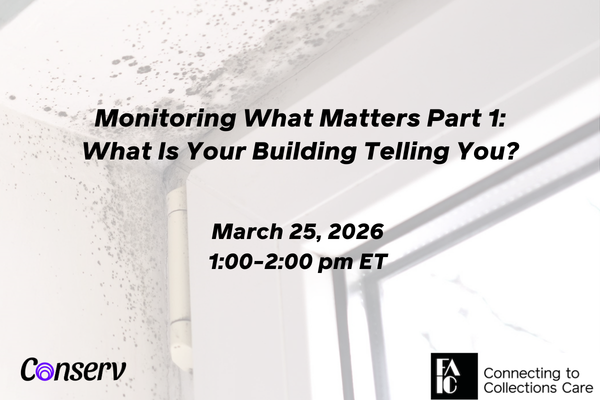

Part 1:
What is Your Building Telling You? |
The Why of Environmental Monitoring
Presented by Megan Brakob Narvey, Outreach Conservator at the Minnesota Historical Society
You're already monitoring. You just might not realize it.
Does your basement smell musty? Is there a persistent leak you manage with a bucket? These observations are the foundation of environmental monitoring, and this webinar helps you understand why they matter for long-term preservation.
You'll discover:
- Risk assessment basics: How temperature, humidity, and other factors specifically impact YOUR collection
- Thinking long-term: Why a 100-year preservation timeframe changes how we evaluate risk
- Building your advocacy case: Using data to support grants, funding requests, and stakeholder presentations
- Everyone has a role: Why monitoring isn't just for conservators—staff, volunteers, and docents all contribute
Real-world impact through case studies:
Learn from institutions that used monitoring data to make critical decisions—from discovering stable storage in unexpected places to identifying mold risks before they became health hazards.
This webinar validates what you already know about your building while giving you the framework to turn observations into actionable preservation strategies. Monitoring isn't about achieving perfection; it's about understanding your environment so you can make informed decisions.
This webinar is perfect for: small museum staff, historic site managers, archivists, volunteers, and anyone who feels monitoring might be "too technical" for their institution.
About the Presenter
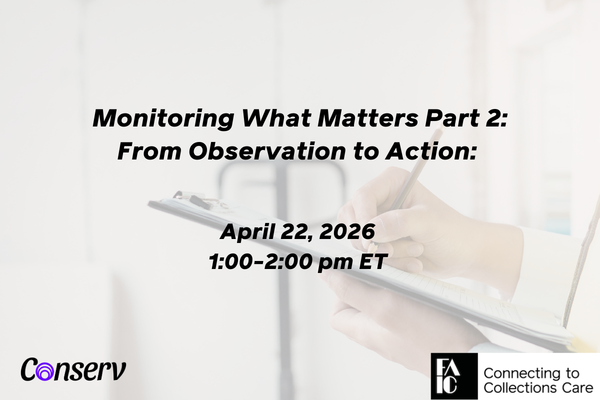

Part 2:
From Observation to Action | The "How" of Environmental Monitoring
Presented by Maddie Cooper, Owner and Principal Conservator of M.C. Conservation Services
Ready to move from awareness to action?
This webinar provides a practical roadmap for implementing a monitoring program that fits your resources. The Environmental Monitoring Cycle is proven five-step framework you can adapt to any scale to monitor any indicator:
- Define Your Goals: What are you trying to learn or protect?
- Create Your Plan: What will you monitor, where, and how often?
- Assess Costs: How much will it cost (both in equipment and labor)?
- Gather Data: How much information will you collect? From where? For how long?
- Analyze and Act: What is the monitoring telling you and how can you act on that information?
This webinar will focus primarily on monitoring temperature and relative humidity, which contribute to deterioration and mold, but the cycle can be applied to any indicator from light to pests and pollutants.
What you'll learn:
- Starting simple with basic tools and observations
- Understanding when to transition to continuous monitoring
- Technology options for different budgets
- Identifying problem areas and strategic monitoring placement
- Available assessment programs and consultation services
Key takeaway: Monitoring doesn't require expensive equipment or scientific expertise to get started. Build a program that grows with your needs, starting from wherever you are today.
Perfect for: Anyone ready to implement monitoring but unsure where to begin, and institutions with existing data loggers they're not actively using.
About the Presenter
Madeline (Maddie) Cooper (she/her) is the owner and Principal Preventive Conservator at M.C. Conservation Services. She has extensive experience in surveys, assessments, and teaching. From 2021–2025, Maddie served as Associate Preventive Conservator at the Conservation Center for Art & Historic Artifacts, where she conducted assessments, developed and taught workshops, and project-managed initiatives such as Preservation Services in Puerto Rico. She has over 10 years of professional collections care experience and previously held conservation and collections roles at Vizcaya Museum and Gardens and the Wolfsonian–FIU. During graduate school, she worked with the Disaster Research Center, the Robert Rauschenberg Foundation, and the Midwest Art Conservation Center. Maddie holds an MS in Art Conservation from the Winterthur/University of Delaware Program in Art Conservation and dual bachelor’s degrees in Chemistry and Art Conservation from the University of Delaware.
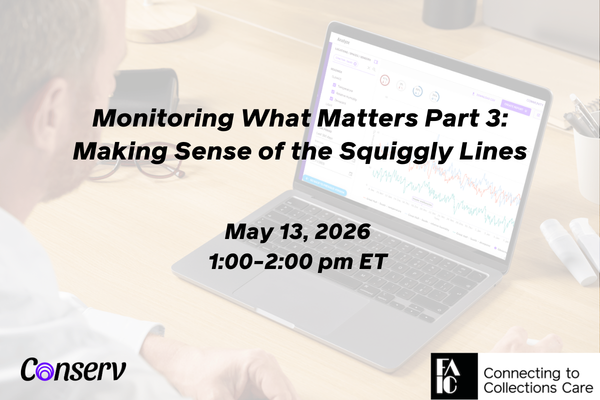

Part 3:
Making Sense of the Squiggly Lines | Understanding and Using Your Monitoring Data
Presented by Maddie Cooper
You've gathered data. Now what? This webinar demystifies data analysis and shows you how to turn numbers into compelling advocacy tools.
Building graph literacy:
- Understanding time-series graphs and key vocabulary (fluctuation, trend, drift)
- Visual aids for interpreting common patterns
- When to be concerned vs. normal variation
- Validating qualitative observations alongside numerical data
Context is everything:
- ASHRAE and industry standards: What they mean (and don't mean)
- Regional considerations: Why Utah and the East Coast need different approaches
- Why your collection's historical conditions matter
- Understanding "proofing" and why stability often beats target numbers
Advocacy and communication:
- Presenting to different audiences: boards, funders, staff, volunteers
- Using data to support grant applications and budget requests
- Sharing monitoring efforts on social media and with the public
- Available support: CAP program, state consultation services, funding opportunities
Overcoming intimidation: This webinar directly addresses that many people find data scary. We'll show you that graph reading is a skill anyone can learn, and you don't need to be a scientist to understand your results.
Key takeaway: Your monitoring data is a powerful tool for advocacy, planning, and preservation—once you know how to read it and talk about it.
Perfect for: Institutions with existing data they don't know how to use, and anyone who needs to present environmental information to stakeholders.
About the Presenter
Madeline (Maddie) Cooper (she/her) is the owner and Principal Preventive Conservator at M.C. Conservation Services. She has extensive experience in surveys, assessments, and teaching. From 2021–2025, Maddie served as Associate Preventive Conservator at the Conservation Center for Art & Historic Artifacts, where she conducted assessments, developed and taught workshops, and project-managed initiatives such as Preservation Services in Puerto Rico. She has over 10 years of professional collections care experience and previously held conservation and collections roles at Vizcaya Museum and Gardens and the Wolfsonian–FIU. During graduate school, she worked with the Disaster Research Center, the Robert Rauschenberg Foundation, and the Midwest Art Conservation Center. Maddie holds an MS in Art Conservation from the Winterthur/University of Delaware Program in Art Conservation and dual bachelor’s degrees in Chemistry and Art Conservation from the University of Delaware.
Presented by
.png?width=400&height=100&name=Heading%20(2).png "c2cc logo")